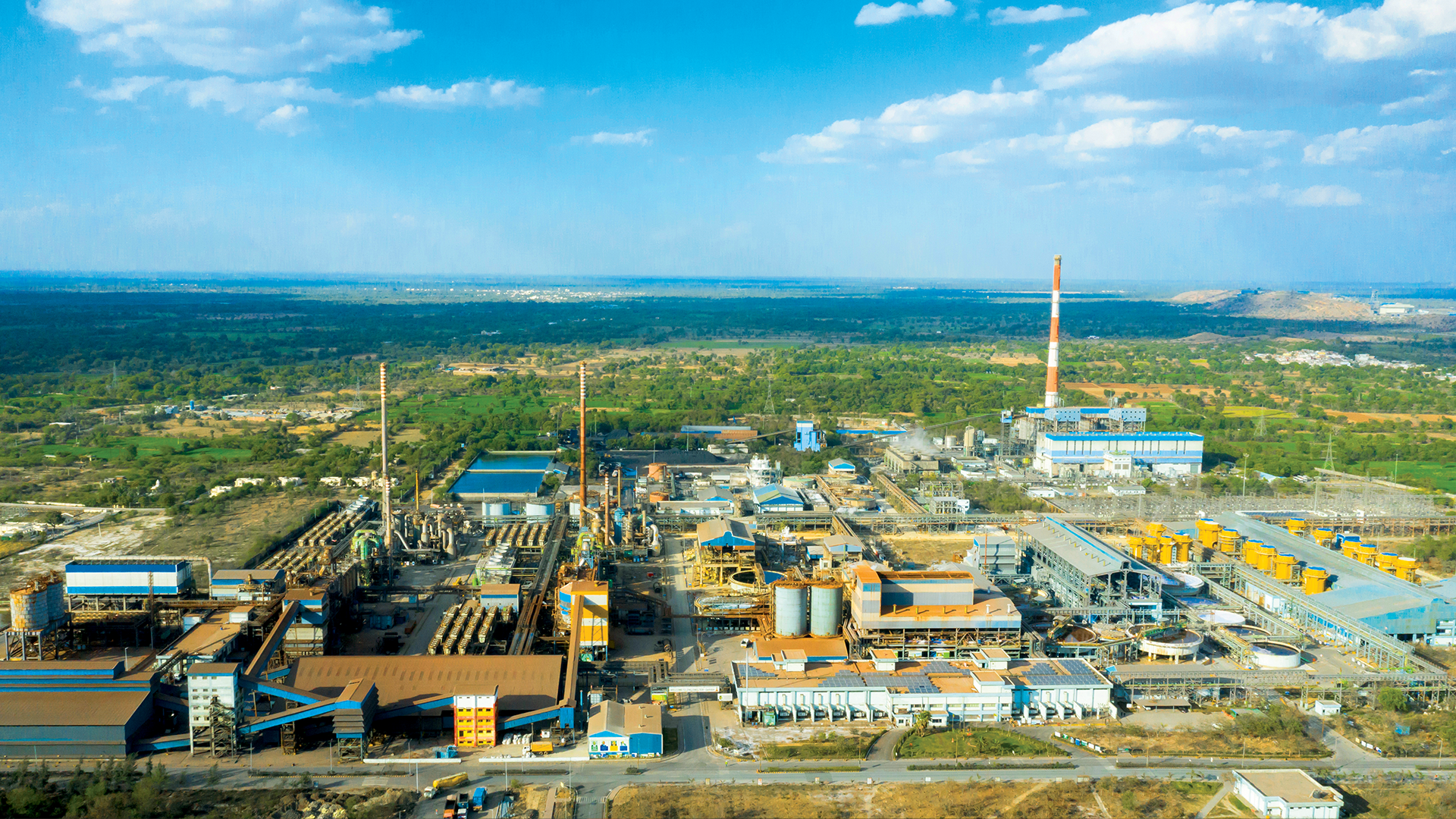

Zinc India is the world’s largest integrated zinc producer and amongst the Top 10 silver producers globally. During the year, the Company achieved a record mined metal production of 1,114 kt, driven by higher ore production and improved mined metal grades. Refined metal production stood at 1,048 kt, supported by the commissioning of debottlenecking projects and the 160 KTPA roaster, including a record refined zinc output of 851 kt, up 3% Y-o-Y. Refined lead production was 197 kt, reflecting a 13% Y-o-Y decline, primarily due to prior-year pyro operations being partially in lead mode and lower plant availability. Refined silver production for the year was 627 tonnes.
In August 2025, Hindustan Zinc achieved a historic milestone by becoming the 25th member of the International Council on Mining & Metals (ICMM), and notably, the first new entrant since 2021. With this achievement, Hindustan Zinc also became the first Indian company to get this prestigious membership, a moment of great significance for both the organisation and the Indian mining industry. As ICMM represents the global benchmark for responsible mining, encompassing leadership in social performance, environmental stewardship, safety, and ethical practices, the Company’s membership marks a transformative step that positions India prominently on the global stage of sustainable and responsible mining.
Furthermore, for the third consecutive year, Hindustan Zinc has been recognised as the global ESG leader in S&P Global Corporate Assessment 2025, being ranked 1st among 235 companies globally in metals and mining sector. With an improvement in overall score to 90 out of 100, the Company also got featured in the Sustainability Yearbook 2026 amongst the top 1% most sustainable organisations globally for the ninth consecutive year.
At Hindustan Zinc, ensuring the safety, health, and well-being of our employees and business partners remains a core organisational priority. Guided by our ‘Zero Harm’ philosophy, we continue to strengthen systems, leadership accountability, and risk management practices to create a workplace where every individual returns home safely. However, during the year, we had two unfortunate fatalities in our operations.
Following detailed investigation, we implemented strong corrective and preventive measures with utmost urgency, and the learnings were disseminated across the organisation. The safety and well-being of every individual remain paramount, and these incidents serve as a reminder of the need for constant vigilance and continuous improvement.
During the year, the Company reinforced its safety governance framework through enhanced risk management systems, leadership capability building, and structured engagement with employees and business partners.
A significant milestone during the year was the rollout of a Critical Risk Management (CRM) centric Safety Management System across operations. The CRM framework focusses on identifying high-consequence risks and ensuring the implementation of effective critical controls to prevent fatalities and serious incidents. As part of this programme, five additional critical risks were launched during FY 2025-26, including risks related to Heavy Earth Moving Machinery (HEMM) fire, ventilation failure, corrosive substances and acids, excavation hazards, and exposure to hazardous gases, strengthening the organisation’s ability to proactively manage high-risk operational scenarios.
Implementation of the CRM framework has significantly strengthened safety monitoring and reporting. During the year, CRM inspections were conducted across operations to ensure the effectiveness of critical controls. Additionally, Safety Action Plans (SAPs) were developed during FY 2025-26, ensuring systematic closure of identified safety gaps. Hazard and Operability Studies (HAZOP) were also conducted across all units to identify emerging risks and strengthen preventive measures.
To further strengthen leadership capability in safety, we conducted S.A.F.E. (Safety Awareness for Excellence in Leadership) Workshops for 42 employees, including 33 Hindustan Zinc employees and 9 business partners. These workshops were designed to enhance frontline leadership capability, strengthen risk ownership, and reinforce behavioural safety practices across operations. Six one-to-one coaching sessions have been completed for 10 identified leaders for strengthening leadership accountability and enhancing safety culture to drive behavioural change.
We also initiated a Safety Culture Survey pilot at Chanderiya Lead-Zinc Smelter, aimed at understanding workforce perceptions, identifying improvement areas, and strengthening the safety culture across operations. Complementing this initiative, focussed Safety Action Meetings were conducted with HEMM operators and engineering teams to address and prevent hand injuries related to HEMM operations.
Business partner engagement remained a key focus area during the year. We conducted Business Partner CEO Connect sessions, creating a platform to reinforce safety accountability, strengthen partnerships, and align business partners with Hindustan Zinc’s safety standards and expectations. We also launched the Mine Safety Assurance Programme, aimed at strengthening safety governance in mining operations through structured assurance mechanisms, periodic reviews, and enhanced oversight of risk controls.
The Company continues to invest in strengthening infrastructure safety through the Infrastructure Inframatrix framework, addressing critical infrastructure risks and enhancing operational reliability.
The Company conducted Quantitative Exposure Assessment (QNEA), PPE fit assessments and ergonomic studies. As a result, 42 high-exposure zones were successfully converted into green zones.
These initiatives reflect Hindustan Zinc’s continued commitment to strengthening safety culture, enhancing leadership accountability, and adopting proactive risk management practices across operations.
The usage of renewable energy has also enabled Hindustan Zinc to launch Asia’s first low carbon zinc, EcoZen, which boasts a carbon footprint of less than 1 tCO2e per tonne of zinc produced, about 75% lower than the global average.
As part of Hindustan Zinc’s Sustainability 2.0 movement, ambitious, globally benchmarked sustainability goals were set for FY 2029-30, which were built onto the baseline of FY 2019-20. The Company’s Science Based Targets include a commitment to 50% reduction in absolute Scope 1 and 2 GHG emissions and further reduction of 25% of absolute Scope 3 GHG emissions by FY 2029-30 from the base year FY 2019-20 and further achieving net-zero emissions across the value chain by FY 2049-50.
As part of our ongoing 530 MW round-the-clock renewable energy (RE-RTC) power delivery agreement with Serentica in addition to the captive solar and waste heat recovery boiler (WHRB) capacity, we sourced around 18% of the renewable energy against the overall power requirement for FY 2025-26. The 530 MW RE-RTC will help in reducing our GHG emissions significantly by 3.5 MtCO2e per annum by FY 2027-28.
The usage of renewable energy has also enabled Hindustan Zinc to launch Asia’s first low carbon zinc, EcoZen, which boasts a carbon footprint of less than 1 tCO2e per tonne of zinc produced, about 75% lower than the global average. In FY 2025-26, the Company has strengthened it’s the long-standing partnerships with Tata Steel and Silox India through adoption of EcoZen across their manufacturing operations.
In FY 2025-26, as part of our commitment to green logistics, we signed two MoUs with Greenline Mobility Solutions Limited to accelerate decarbonisation of supply chains. The first marks India’s first such commercial-scale initiative of deploying 100 electric vehicle (EV) trucks with battery swapping for concentrate movement between mines and smelters. The second adds liquified natural gas (LNC) trucks to our finished goods logistics fleet, doubling our LNG capacity, advancing cleaner, more sustainable logistics. Hindustan Zinc, in collaboration with Enviiiro Wheels Mobility Pvt Ltd., has flagged off first 10 EV bulker trucks at Zinc Smelter Debari, resulting in total 20 EV trucks for interunit transport of goods.
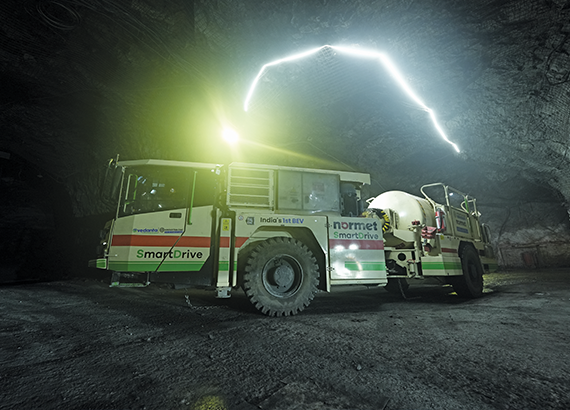
Our other initiatives in reducing our Scope 3 emissions include deploying 3 battery-electric vehicles (BEVs) in our underground operations at Sindesar Khurd Mine, as well as deployment of 180 LNG-powered trucks in partnership with Greenline, for upstream & downstream transportation.
We have effluent treatment plants (ETPs) and water treatment plants (WTPs) at all our operations which recycle processed water, which is then reused in operations making the Company maintain its zero liquid discharge. The most recent addition is water treatment plant at Rampura Agucha Mine. We have two operational dry tailing plants (DTP), one at Zawar Mines and one at Rajpura Dariba Mine, each of which recirculate more than 80% of the process water present in tailings.
We ensured effective waste management practices during the year, with the fumer technology at Chanderiya continuing its ramp-up to recover lead and silver cake from jarosite. Through the fumer plant, we achieved a reduction of 1,00,758 MT of jarosite, while a further 6,53,931 MT of jarosite and jarofix was utilised across the cement industry, road construction and railway infrastructure, reinforcing our commitment to sustainable waste utilisation.
We have engaged with the International Union for Conservation of Nature (IUCN) for preparing biodiversity management plans (BMPs) for all of our locations, except the Pantnagar Metal Plant, to support Hindustan Zinc to achieve its target of no net loss of biodiversity against a 2020 baseline. The implementation plans are under place, and implementation is under progress at all sites.
In FY 2025-26, Hindustan Zinc has filed 2 Indian patents concentrating in fields of sustainable metal valorisation from smelters waste, automation of product quality check while running electrowinning process and mineral processing – generation of pyrite from tailings. Furthermore, the Company has signed two MoUs with Council of Scientific and Industrial Research (CSIR) – National Metallurgical Laboratory (India) and Virginia Tech University, US, focussing on strengthening process related to metal grade improvements in mineral processing coupled with innovative techniques for strategic metal extraction across the Company.
As part of our continued collaboration with Indian Institute of Technology (IIT) Madras and Jawaharlal Nehru Centre for Advanced Scientific Research (JNCASR), we are working on advancing the development of next-generation battery storage solutions. JNCASR has developed and demonstrated a zinc-ion pouch cell prototype. In parallel, IIT Madras is working on developing a zinc-air battery prototype and has successfully demonstrated it at lab scale, with ongoing work focussed on vehicle-level demonstration as a range extender. These collaborations aim to enhance the viability of zinc-based batteries for a sustainable energy future.
We also organised a series of training sessions called “Wednesday for Transition”, which were designed to provide suppliers with essential knowledge on ESG (Environmental, Social, and Governance) topics like psychological health & safety, safety, human rights, etc.
| Particulars | FY 2025-26 | FY 2024-25 | % Change |
|---|---|---|---|
| Total mined metal | 1,114 | 1,095 | 2% |
| Refinery metal production | 1,048 | 1,052 | (0%) |
| Refined zinc – integrated1 | 851 | 827 | 3% |
| Refined lead – integrated | 197 | 225 | (13%) |
| Production – silver (in tonnes) | 627 | 687 | (9%) |
1. Includes 13.7 kt and 10.1 kt from Hindustan Zinc Alloys (100% subsidiary of Hindustan Zinc) in FY 2025-26 and FY 2024-25, respectively.
FY 2025-26 recorded the best-ever mined metal production of 1,114 kt compared to 1,095 kt in the prior year driven by higher ore production, improved mined metal grades, and operational efficiencies. For the full year, ore production was 16.6 million tonnes, 2% up Y-o-Y, supported by higher output at Rampura Agucha, Zawar and Kayad Mines.
Refined metal recorded the second-highest volume in FY 2025-26 at 1,048 kt, almost in line with FY 2024-25. Refined zinc production was 851 kt, up 3% Y-o-Y, supported by commissioning of smelter debottlenecking projects and the 160 KTPA roaster. Refined lead production was 197 kt, down 13% Y-o-Y, mainly due to prior-year pyro operations being partially in lead mode and lower plant availability.
| Particulars | FY 2025-26 | FY 2024-25 | % Change |
|---|---|---|---|
| Average zinc LME cash settlement prices US$ per tonne | 2,970 | 2,875 | 3% |
| Average lead LME cash settlement prices US$ per tonne | 1,954 | 2,046 | (5%) |
| Average silver prices US$/ounce | 53.09 | 30.39 | 75% |
In FY 2025-26, zinc prices showed periods of strength on the London Metal Exchange (LME), supported by tightening concentrate markets and improved investor sentiment. Global refined zinc production reached 13.85 MT (+4% Y-o-Y) in CY2025 while consumption increased to 13.66 MT (+0.6% Y-o-Y). Concentrate tightness intensified through the year, pushing spot treatment charges down, significantly pressuring smelter margins. Despite weak construction demand globally, moderate improvements in industrial activity, particularly in China’s auto sector and India’s infrastructure push, supported overall metal demand. As a result, zinc prices averaged at US$ 2,970/t in FY 2025-26, up 3% higher than FY 2024-25.
Global refined lead demand increased to 14.24 MT (+0.5% Y-o-Y) in CY2025; refined lead production increased to 14.35 MT (+1% Y-o-Y). Global primary mine output increased to 4.44 MT (+3.4% Y-o-Y). Lead prices remained relatively softer in FY 2025-26, averaging at US$ 1,954/t and settling below US$ 1,900/t.
During FY 2025-26, silver prices advanced sharply, supported by expectations of monetary easing in the US, heightened geopolitical risks and tightness in the physical market. Investment participation strengthened alongside steady industrial demand from electronics and power infrastructure supply chains. Prices touched a historic high of US$ 118.45 per troy ounce in January 2026 and averaged at US$ 53.1 per troy ounce in FY 2025-26, reflecting a 75% year-on-year increase. With limited new mine capacity additions and structurally higher industrial consumption, market sentiment for silver remained constructive.
Its outlook is defined by a persistent physical tightness, as the market enters its sixth consecutive year of structural deficit. It sustains an optimistic environment where the metal’s dual role as a safe-haven hedge and a critical technology mineral has established a significantly higher price floor compared to previous years.
| Zinc Global Balance in kt | CY2024 | CY2025 | CY2026E |
|---|---|---|---|
| Mine Production | 12,212 | 12,910 | 12,385 |
| Smelter Production | 13,310 | 13,847 | 13,736 |
| Consumption | 13,574 | 13,659 | 13,799 |
Source: Wood Mackenzie
The global refined zinc demand is showing signs of improvement around the world with major momentum gains expected to be driven by the Asian economies. A pickup in global manufacturing activity and increased investments by Chinese authorities are expected to back this momentum.
In case of global zinc supply, if the existing delays in the major mine projects sustain, it can result in a continued tight concentrate market, impacting the refined metal production, which would also be impacted by profitability-related and environment-related smelter suspensions across the globe.
In CY2025, LME warehouse stocks trended downward, falling from 141 kt to 115 kt, with the year’s highest level of 195 kt recorded in April 2025. Meanwhile, SHFE stocks moved in the opposite direction, increasing from 72 kt to a high of 149 kt.
The market has faced a persistent deficit driven by supply-side constraints, with stocks dropping to critical levels. This deficit is expected to persist into FY 2026-27, driven largely by supply side constraints and intensified further by the current conflict in the Middle East. This tightness is underpinned by historically low visible inventories, persistent concentrate scarcity, and constrained mine supply. Although supply pressures may ease modestly toward the end of FY 2026-27 as new capacities ramp-up, overall market tightness will continue to define the near-term outlook.
India’s manufacturing PMI stood at 53.8 in March 2026, indicating sustained expansion in manufacturing activity, while the global manufacturing PMI improved to 51.3, marking its second-highest level since June 2022. According to industry data, India’s crude steel production increased by 10.4% to 164.9 MT during CY2025, significantly outperforming global trends and reflecting strong domestic demand momentum. In contrast, global crude steel production declined by 2.0% to 1,849.4 MT over the same period.
India’s economic outlook remains robust, with real GDP growth estimated at ~7.6% in FY 2025-26 and projected in the range of 6.4%-6.9% in FY 2026-27 as per various estimates. Steel demand in India is expected to remain among the strongest globally, with finished steel demand projected to grow by 5-7% in FY 2026-27, supported by continued public capital expenditure and infrastructure development. This growth is underpinned by the FY 2026-27 Union capex outlay of ₹ 12.2 lakh crore, along with sustained investments under large scale programmes such as the National Infrastructure Pipeline, rail and road expansion, and urban infrastructure initiatives. Consequently, India is expected to become the world’s third-largest zinc consumer by 2030, driven by rising galvanisation demand from the construction and automobile sectors.
| Particulars | FY 2025-26 | FY 2024-25 | % Change |
|---|---|---|---|
| Unit costs (US$ per tonne) | |||
| Zinc (including royalty) | 1,370 | 1,440 | (5%) |
| Zinc (excluding royalty) | 959 | 1,052 | (9%) |
For the full year, Zinc COP excluding royalty recorded its 5-year lowest of US$ 959 per tonne, down by 9% Y-o-Y. The reduction in COP has been achieved mainly driven by the lower power cost due to higher domestic coal usage, softened coal prices and increased renewable energy usage, higher by-product realisation and better metal grades, partly offset by higher mine development. This reflects the continuous improvement through various cost saving initiatives, strong operational performance and digital transformation which helped in achieving lowest zinc cost of production in last 5 years.
Revenue from operations for the year was ₹ 39,057 crore, up 19% Y-o-Y, driven by higher zinc and silver prices, lead concentrate sale, higher by-product realisation, and a stronger dollar. EBITDA for FY 2025-26 was at ₹ 22,056 crore, up by 27% Y-o-Y in line with higher zinc and silver prices, lower cost of production, lead concentrate sale, and a stronger dollar, partly offset by lower production.
(₹ crore, unless stated)
| Particulars | FY 2025-26 | FY 2024-25 | % Change |
|---|---|---|---|
| Revenue | 39,057 | 32,903 | 19% |
| EBITDA | 22,056 | 17,365 | 27% |
| EBITDA margin (%) | 56% | 53% | - |
 Awards & Accolades
As Hindustan Zinc advances in the journey towards 2 MTPA integrated metal expansion, several projects have been undertaken throughout the year:
While the 250 KTPA integrated refined zinc capacity expansion and the tailings reprocessing plant fall under Phase 1 towards doubling the capacity, further projects forming the Phase 2 will be announced, as and when they are approved by the Board.
Hindustan Zinc has driven exploration with an aim to add new resources, upgrade existing resources into reserves category and expand its overall R&R base. This strategy supports the company’s goal of achieving a 2x growth in operations. The Company has established a dedicated exploration subsidiary named ‘Hindmetal Exploration Services Pvt Ltd (HESPL)’, a NABET-accredited Category-A exploration agency in the mineral sector and currently all exploration initiatives are being driven by this agency.
The Company has undertaken initiatives to enhance reserves and resources within the leasehold areas. Accelerated technology adoption, technical competence and innovative operational approaches play key roles to improve exploration performance. New prospective targets were identified along with optimally designed drill holes to examine the continuity of mineralisation.
In line with previous years, the Mineral Resource is reported on an exclusive basis to the Ore Reserve, and all statements have been independently audited by SRK (UK).
On an exclusive basis, Hindustan Zinc’s total Ore Reserves and Resources (R&R) stood at a record 468.6 million tonnes at the end of FY 2025-26. Ore Reserves amounted to 219.1 million tonnes, net of depletion of 16.6 million tonnes during FY 2025-26, while Mineral Resources totalled 249.5 million tonnes. The contained metal within Ore Reserves is estimated at 10.7 million tonnes of zinc, 3.3 million tonnes of lead, and 350.8 million ounces of silver. Mineral Resources contain approximately 10.8 million tonnes of zinc, 4.4 million tonnes of lead, and 426.0 million ounces of silver. At current mining rates, the robust R&R base supports metal production visibility for more than 25 years.
In addition to the existing zinc-lead-silver mining leases, the Company is actively pursuing exploration opportunities for the three earlier acquired critical mineral blocks – namely Tungsten in Andhra Pradesh, Potash in Rajasthan, and Rare Earth Elements in Uttar Pradesh. They are aimed at expanding and diversifying its mineral portfolio in critical minerals, positioning it as a future-ready multi-metal energy transition. Company has received the Letter of Intent (LoI) for all 3 blocks and is now working towards completing other regulatory approvals, post which the focus will be on completing the exploration in three years.
In addition to the above, currently, nine exploration projects of different commodities including Gold, Copper, Nickel-Chromium-PGE’s, Tungsten, Cobalt, Manganese, Vanadium and Graphite are being managed under Hind-metal Exploration Services Private Limited (HESPL) across 7 states of India.
Our primary focus remains on enhancing overall output, cost efficiency of our operations, diversifying our portfolio, disciplined capital expenditure and sustainable operations. With the optimistic global economic outlook for Hindustan Zinc, our goals over the medium term remain unchanged.
Our key strategic priorities include