Vedanta plays a foundational role in India’s development story, as one of the country’s most significant producers of critical natural resources and a company whose operations span energy, metals, mining, and technology at a national scale. Over six decades, this presence has been shaped by a conviction that industrial scale and responsible conduct are not competing priorities but mutually reinforcing ones. With a steadfast commitment to sustainability, ethical governance, and community stewardship, Vedanta integrates ESG principles into the architecture of its operations, aligning with global benchmarks and contributing to India’s progress toward self-reliance, inclusive prosperity, and long-term resilience.
Our philosophy, ‘Building on Legacy, Synergising Value, Scaling Impact’, captures the moment Vedanta is in. It is a company that honours its foundation while transforming its structure: strategic demergers are creating focussed, sector leading entities with dedicated capital and sharper accountability, each empowered to meet global sustainability expectations with greater precision. ESG is not a framework applied to the business. It is the framework within which every strategic decision is made, from how we govern tailings and decarbonise operations, to how we invest in communities and build the workforce of the future. The ambition is clear. The accountability is by design.
This evolution empowers each independent entity to meet specific global sustainability expectations with greater precision, while carrying forward the standards, targets, and accountability mechanisms that bind our portfolio together. Our ESG commitments travel with each business unchanged.
The challenges we face, from climate change and water security to biodiversity, social inclusion, human rights, and governance, require integrated responses embedded at every level of the organisation. Our framework addresses these through three strategic pillars: Transforming Communities, which focusses on empowering 2.5 million families through education, healthcare, and skills; Transforming the Planet, which targets a 25% reduction in our carbon footprint and integration of 2.5 GW of renewable energy RTC; and Transforming the Workplace, which advances workforce safety, health, and inclusive diversity across our operations.
Building internal capability is central to this effort. Through the Vedanta Academy for Sustainability (VEDAS), we equip our employees and partners to embed ESG principles into everyday business decisions, ensuring our sustainability commitments translate into operational reality across all sites and functions.
Launched in February 2025, the Vedanta Academy for Sustainability (VEDAS) embeds ESG capability across every function and level of the organisation. It is built on a simple premise: sustainability is integral to all business decisions, not a standalone function.
Through a science-led, action-oriented curriculum aligned with Vedanta’s operations, VEDAS enables employees to evaluate everyday decisions through an ESG lens, integrating risk, compliance, resource efficiency, and long-term resilience into core processes.
Structured along an “Understand, Act, Lead” pathway, the programme reached around 7,000 executive employees at the Foundation level in FY 2025-26, establishing a common baseline in sustainability fundamentals. Ongoing engagement mechanisms, including the VEDAS Monthly Quiz, help build a network of Business Unit Ambassadors.
The Champion Programme forms the leadership tier, converting engaged employees into action-oriented leaders who drive on ground implementation through community linked missions. Looking ahead, VEDAS will scale to over 25,000 learners, expand to include the social dimension of ESG, and introduce a dedicated Sustainability Month. By FY 2029-30, it aims to reach over 1,00,000 employees and partners, embedding sustainability-led decision-making across Vedanta’s operations.
Progress is tracked through a combination of mechanisms, with the ESG Scorecard serving as a core tool rather than the sole measure. The Scorecard monitors each Aim through time-bound KPIs with defined baselines and short-, medium-, and long-term targets to FY 2029-30. This is complemented by regular operational reviews, real-time implementation tracking, and continuous feedback loops embedded across business units.
Performance is reviewed monthly by the ESG Executive Committee and reported biannually to the Board, with ESG parameters carrying a 15% weighting in leadership performance linked KPIs. The governance framework emphasises transparency, leadership accountability, and alignment with BRSR, GRI, TCFD, TNFD, and SASB standards, alongside active engagement with investors, regulators, communities, and employees to ensure strategies deliver measurable and shared value.
Accountability by design, not by declaration
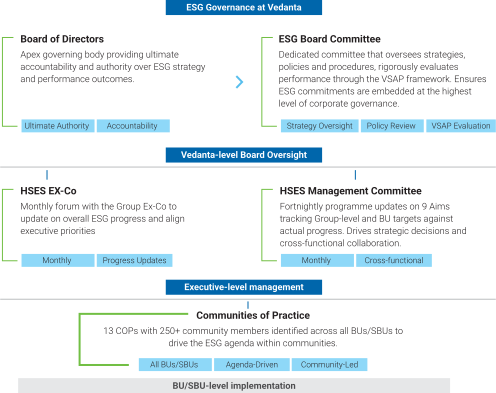
Our ESG governance architecture clearly distributes accountability across four interlocking levels while preserving the agility to respond to an evolving ESG landscape.
The defining feature of this architecture is its two-directional flow. Strategy, standards, and direction move downward from the Board. Performance intelligence, operational learning, and ground-level innovation move upward through our 13 Communities of Practice. Neither direction functions without the other. The quality of that two-way exchange is what determines whether our ESG commitments translate into measurable outcomes.
 Biodiversity
 Communication
 Community
 Energy & Carbon
 Expansion
 Finance
 Health
 People
 Safety
 Security
 Social Performance
 Waste
Waste Water
WaterOur ESG governance operates through interlocking levels, each with a defined remit, cadence, and set of decision rights. No level operates in isolation; each one feeds into and draws from the levels adjacent to it.
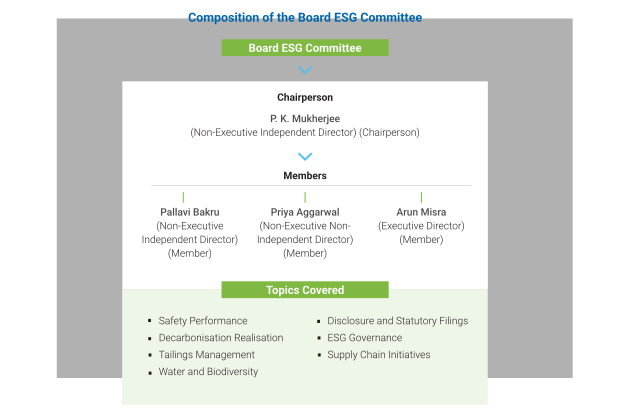
The Board ESG Committee is the apex accountability body for Vedanta’s sustainability performance. It sets strategic direction, reviews progress against material ESG issues and ensures our ESG agenda keeps pace with evolving global standards, stakeholder expectations, and regulatory requirements. The Committee meets twice a year, and its agenda directly shapes the priorities of the HSES Management Committee, the Communities of Practice, and BU-level implementation plans for the period ahead.


At the executive level, three entities work in coordination to bridge strategy and execution, providing monthly updates and ensuring alignment with business priorities.
The HSE & Sustainability (HSES) Executive Committee , operating as part of the Group Ex-Co, convenes monthly to update Group leadership on overall ESG progress. The ESG team directs initiatives under this committee, collaborating with internal and external stakeholders to ensure strategic priorities are translated into action.
The HSES Management Committee meets monthly for programme updates across all nine Aims at both Group-level and BU targets against actual progress, managing key decisions on strategic direction and cross-functional support.
At the BU and SBU levels, dedicated ESG teams manage on-ground implementation, translating Group-level commitments into site-specific actions that are stress-tested against real world conditions, including resource constraints, community dynamics, and production realities.
ESG ownership at this level is both structured and distributed. Dedicated BU ESG teams ensure sustainability is embedded within core operational decision-making, with ESG performance metrics sitting alongside production, safety, and financial KPIs in routine management reviews, reinforcing a culture where environmental and social considerations carry equal weight to operational targets.
Communities of Practice bring together representatives from multiple functions to oversee community-focussed initiatives, ensuring strong social performance by addressing stakeholder concerns and fostering meaningful engagement. By anchoring expertise within practitioner communities rather than relying solely on top-down directives, Vedanta builds institutional knowledge that is resilient, transferable, and deeply contextual, accelerating problem-solving and reducing duplication of effort across sites.
Together, these mechanisms strengthen Vedanta’s social licence to operate and align its actions with global sustainability standards, ensuring ESG ambitions are not confined to policy documents but are implemented, tracked, and measured daily across its diverse operational portfolio. In FY 2025-26, our CoPs conducted over 250 meetings, each a structured forum where site-level practitioners, functional experts, and BU ESG leads align on progress, resolve implementation barriers, and share innovations across the organisation.
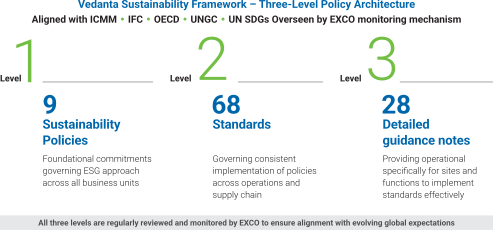
The Vedanta Sustainability Framework (VSF) serves as the foundation for integrating sustainability into our business operations and decision-making processes. It ensures that we generate positive impacts across our entire value chain while maintaining operational excellence, aligned with globally recognised standards established by the International Council on Mining and Metals (ICMM), International Finance Corporation (IFC), the Organisation for Economic Co-operation and Development (OECD), United Nations Global Compact (UNGC), and the Sustainable Development Goals (SDGs).
The VSF is supported by a three-level architecture of policies, standards, and guidance documents that are regularly reviewed and monitored to ensure alignment with evolving global expectations.
Through the VSF, we provide education, training, and capacity-building opportunities for employees and business partners to strengthen their understanding of and ability to implement sustainability principles. To read more about our policies, standards, and guidance notes, please visit our website: Link.
The VSF establishes what we are committed to and how we manage it. The Vedanta Sustainability Assurance Programme then verifies that those commitments are being honoured across all business units and geographies.
The Vedanta Sustainability Assurance Process (VSAP) is our primary internal audit mechanism for ensuring the effective implementation of the Vedanta Sustainability Framework across all business units. It functions as a structured performance monitoring and risk management tool, enabling the Group to assess ESG compliance and track progress across critical sustainability parameters.
Through systematic evaluation of environmental management, health and safety, community engagement, and human rights, VSAP identifies performance gaps and facilitates timely corrective action plans with continuous evaluation to strengthen overall sustainability outcomes. The programme operates through a structured annual cycle of internal assessments, continuous monitoring, and periodic validation by subject matter experts. Findings are reviewed by the Sustainability and Executive Committees and reported to the Board, ensuring strong governance and accountability at the highest level.
To reinforce leadership ownership of sustainability priorities, ESG parameters assessed through VSAP are embedded into leadership performance metrics, with sustainability criteria carrying a 15% weighting in annual performance-linked KPIs that influence executive compensation. By linking assurance, accountability, and performance, VSAP plays a critical role in driving consistent progress toward sustainability across the organisation.
Our ESG Scorecard translates the commitments of our Transforming for Good framework into a structured performance management tool. Each of the nine Aims is tracked through specific KPIs with defined baselines, annual goals, and long-term targets to FY 2029-30. Progress is reviewed monthly by the ESG Executive Committee, reported bi-annually to the Board, and independently assured on an annual basis. The Scorecard is the mechanism through which our sustainability ambitions become obligations: trackable, reportable, and accountable.
| KPIs | FY 2025-26 goal | FY 2029-30 goal | Baseline | FY 2025-26 progress | Material topics | UN SDGs | NGBRC |
|---|---|---|---|---|---|---|---|
| Impact Management | Zero social incidents category 4 and above | - | - | Zero | Community engagement and development | 8.3 | |
| Transparency & Trust | Signatories and participants in VPSHR | Application for VPSHR membership has been put on hold in light of the on-going demerger process. | |||||
| Annual Human Rights assessment across all the businesses | Human Rights assessment undertaken across all operations | Principle 5 |
| KPIs | FY 2025-26 goal | FY 2029-30 goal | Baseline | FY 2025-26 progress | Material topics | UN SDGs | NGBRC |
|---|---|---|---|---|---|---|---|
| Skilling (Number of individuals to be impacted through skill development and training) | 1.5 million individuals | 2.5 million individuals | 0.6 million individuals (FY 2015-16) | 1.75 million individuals | Community engagement and development | 2.3 2.4 4.4 8.3 | Principle 8 |
| KPIs | FY 2025-26 goal | FY 2029-30 goal | Baseline | FY 2025-26 progress | Material topics | UN SDGs | NGBRC |
|---|---|---|---|---|---|---|---|
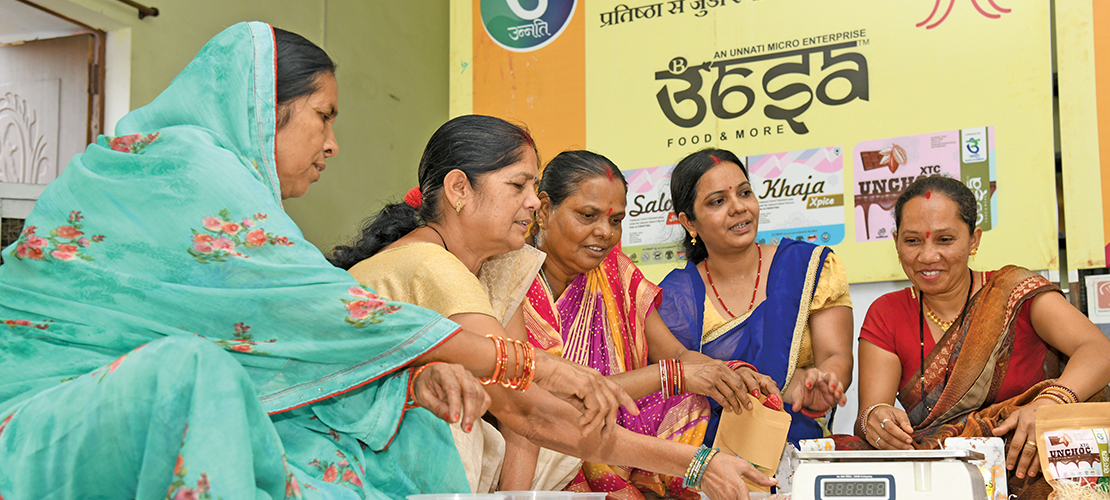
| Nand Ghar (Number of Nand Ghars to be completed) | ~9,000 | 29,000 | - | 12,769 Operational Nand Ghars | Community engagement and development | 2.1, 2.2, 4.1, 4.2 2.3, 2.4, 4.4, 8.3 | Principle 8 |
| Education, Nutrition, Healthcare, and Welfare | 48 million | - | 6.46 million (FY 2020-21) | 31.09 million till FY 2025-26 |
| KPIs | FY 2025-26 goal | FY 2029-30 goal | Baseline | FY 2025-26 progress | Material topics | UN SDGs | NGBRC |
|---|---|---|---|---|---|---|---|
| Absolute GHG emissions (% reduction from FY 2020-21 baseline) | - | 25% reduction by 2030 | 60.24 million tCO2e | 71.45 million tCO2e | Climate change and energy transition | 7.2 12.2 13.2 | Principle 6 |
| GHG Emissions Intensity (% reduction from FY 2020-21 baseline) | 20% reduction by FY 2025-26 (across the metals businesses) | - | 6.44 tCO2e/MT | 5.51 tCO2e/MT (~14% reduction from baseline) | |||
| Renewable Energy | 500 MW RE RTC or equivalent | 2.5 GW of RE RTC or equivalent | 67 MW | 454 MW | |||
| LMV Decarbonisation (% LMVs) | 50% | 100% | - | 14% | |||
| Capital Allocation for transition to net zero | - | US$ 5 billion | - | US$ 1 billion invested till FY 2025-26 | |||
| Hydrogen as Fuel | - | Commitment to accelerate the adoption of hydrogen as a fuel and seek to diversify into H2 fuel or related businesses | - | No significant action in FY 2025-26, remains open for future exploration |
| KPIs | FY 2025-26 goal | FY 2029-30 goal | Baseline | FY 2025-26 progress | Material topics | UN SDGs | NGBRC |
|---|---|---|---|---|---|---|---|
| Net Water Positivity | - | >1 Ratio | 0.52 (FY 2020-21) | 0.64 | Water and wastewater management | 6.3 6.4 6.5 6.b | Principle 6 |
| Freshwater consumption (% reduction from FY 2020-21 baseline) | 15% | - | - | 0.43% increase from baseline | - | ||
| Water-related Incidents | Zero category 4 and 5 incidents related to water | - | - | Zero water related incidents | - | ||
| Water Recycling (%) | 33% | - | - | 38% | - |
| KPIs | FY 2025-26 goal | FY 2029-30 goal | Baseline | FY 2025-26 progress | Material topics | UN SDGs | NGBRC |
|---|---|---|---|---|---|---|---|
| Ash (Fly ash, bottom ash, pond ash) Utilisation | Sustain 100% Utilisation | - | - | 101% | Circularity and waste management | 12.5 | Principle 6 |
| Legacy Ash | - | Zero Legacy Ash | - | 8.74 million MT | |||
| Waste Utilisation (High volume, low toxicity) | 100% | 100% | - | 98% | |||
| Tailings dam audit and findings closure | All tailings facilities are audited, and actions are closed with real-time monitoring | Align with GISTM conformance | - | All tailings facilities audited by third party. GISTM conformance is being re-calibrated. | Tailings management | ||
| Biodiversity risk | Review of site biodiversity risk across all our locations | - | - | 100% sites had been assessed for biodiversity risk in FY 2024-25 | Biodiversity and ecosystems | 15.1 15.2 15.9 | |
| Habitat Restoration | Determine the feasibility for commitment to No-Net-Loss or Net Positive-Impact (NNL/NPI) targets | Roadmap to achieve No Net-Loss or Net-Positive Impact in place | - | Feasibility analysis for Nature Positive future is under progress |
| KPIs | FY 2025-26 goal | FY 2029-30 goal | Baseline | FY 2025-26 progress | Material topics | UN SDGs | NGBRC |
|---|---|---|---|---|---|---|---|
| Fatalities | Zero | - | 8 in (FY 2020-21) | 4 | Health, safety and well-being | 8.8 | Principle 3 |
| Lost Time Injury Frequency Rate (LTIFR) | 10% reduction (Y-o-Y) | - | 0.56 (FY 2020-21) | Employees: 0.35 (5.4%) ; Workers: 0.45 (18.2%) Total: 0.44 (15.4%) % denotes reduction from FY 2024-25 | |||
| Total Recordable Injury Frequency Rate (TRIFR) | 0.98 (30% reduction from FY 2020-21 baseline) | 0.8 TRIFR per million-man hours | 1.48 (FY 2020-21) | Employees: 1.02 (5.6%) ; Workers: 1.3 (14%) Total: 1.30 (12%) % denotes reduction from baseline | |||
| Occupational Health Management Systems | Health performance standards implemented and part of VSAP | - | - | Health performance standards have been implemented as part of VSAP | |||
| Exposure Monitoring | Employee and community exposure monitoring to be completed | No employee exposure to red zone areas | - |
Exposure monitoring is conducted on a bi-annual basis, and all existing business units have completed their assessments in accordance with the defined schedule. Repeat exposure studies carried out during the cycle revealed a 36% increase in red zones in the areas assessed. Monitoring for newly added business units, including two units originally scheduled for FY 2025-26, will now commence in FY 2026-27. Based on action plans implemented following studies conducted during 2024-26, a 62% reduction in red zones is projected; actual outcomes will be validated through periodic monitoring in line with the defined study cycle. |
|||
| Employee Well-being | Mental health programme in place for all employees | - | - | All business units have a mental health programme in place, except for one BU, which is planned for implementation in FY 2026-27. | |||
| Employee well-being | 100% of eligible employees to undergo periodic medical examinations | Number of planned and underwent periodic medical examinations for direct employees and Business Directors | - | 100% eligible employees have undergone initial medical examination and 99% of eligible employees have undergone periodic medical examination |
| KPIs | FY 2025-26 goal | FY 2029-30 goal | Baseline | FY 2025-26 progress | Material topics | UN SDGs | NGBRC |
|---|---|---|---|---|---|---|---|
| Gender diversity (% women in the FTE workforce) | - | 30% | 10% | 23% | Diversity and equal opportunity | 5.1 5.5 5.c | Principle 3 |
| Gender diversity (% women in leadership roles in FTE workforce) | - | 40% | - | 9% | |||
| Gender diversity (% women in decision-making bodies in FTE workforce) | - | 30% | - | 26% | |||
| Gender diversity (% women in technical leader/shop floor roles in FTE workforce) | - | 10% | - | 13% |
| KPIs | FY 2025-26 goal | FY 2029-30 goal | Baseline | FY 2025-26 progress | Material topics | UN SDGs | NGBRC |
|---|---|---|---|---|---|---|---|
| Supply Chain GHG Transition | Work with our long-term, tier 1 suppliers to submit their GHG reduction strategies | Align our GHG reduction strategies with our long-term tier 1 suppliers | - | - | Supply chain sustainability | 8.7 | Principle 6 |
| Training on Code of Conduct | Continue to cover 100% of employees | - | 100% of our employees undergo the Code of Conduct Training | Business ethics and corporate governance | Principle 1 | ||
| % Independent Directors on Board | 50% Independent Directors on Board as per SEBI requirements | 50% Independent Directors on Board as per SEBI requirements | Principle 1 | ||||
| % gender diversity on the board | 25% | 25% | Principle 1 |


