×
Risk Management Risk Management
Risk Management

Resilience across EVERY GROWTH ENGINE

Our approach to risk management focusses on building resilience across the organisation through a welldefined framework and strong governance oversight. Structured processes support the early identification and evaluation of risks across our global operations, allowing timely mitigation and informed decisionmaking. Risk perspectives remain closely connected with strategic planning and operational execution, enabling the business to respond effectively to changing market, regulatory and operational conditions.

During the year, the framework underwent a comprehensive refresh, including the articulation of risk appetite statements, recalibration of scoring methodologies, reassessment of risk scales, and identification of key risk indicators, strengthening the structure and objectivity of risk insights. Continuous monitoring and refinement of the risk landscape ensure preparedness for emerging challenges, reinforcing risk awareness throughout the organisation and protecting long-term value while enabling pursuit of opportunities.

Risk governance framework

Board of Directors
Audit and Risk Management Committee
GRMC1
ExCo2
Business Unit Management Teams

Note:
1. GMRC: Group Risk Management Committee   2. Executive Committee

Group Risk Governance Framework

EVALUATE Strategic
IDENTIFY External
MITIGATE Operational
MONITOR Financial

Enterprise Risk Management

Our risk framework balances materiality and defined risk tolerance levels to provide reasonable assurance against significant losses. A structured and consistent process enables clear identification, assessment and reporting of risks to the Board. Established management systems, operating processes and strong ethical standards guide the way risks are monitored and addressed across the organisation.

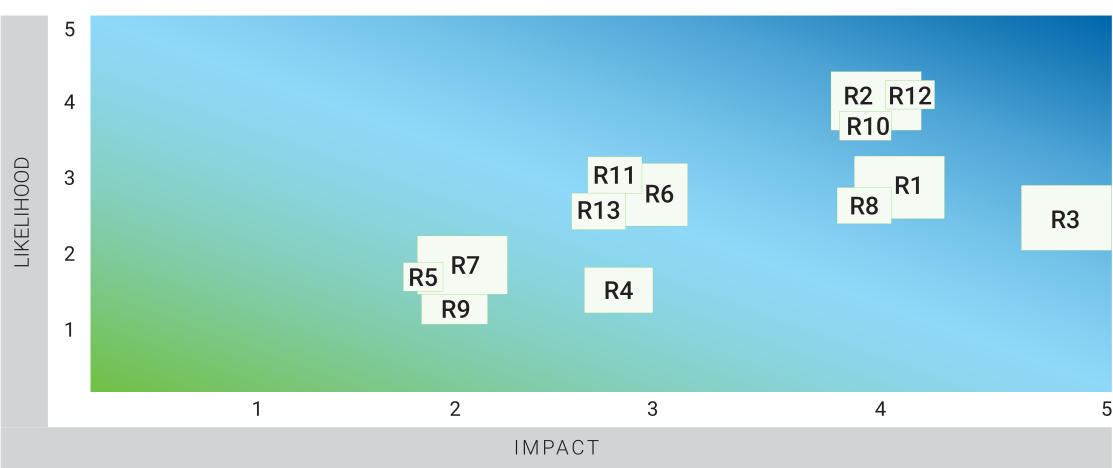
Risk heat map

Risk heat map plotting residual risk profile of risks R1 to R13 by likelihood (1-5) against impact (1-5)

Heatmap represents residual risk profile

Changes made to Risk Matrix:

  1. Residual risk for “Managing Relationship with Stakeholders” increased. The risk has been modified to include “licence to operate” within its ambit.
  2. Both inherent risk and residual risk increased for “Cairn-Related Challenges”.
  3. Reassessed inherent and residual scores for ‘Tax related matters’ basis revised scales.

Approach to Risk Identification

Risks across existing operations and ongoing projects are identified using a standardised assessment methodology and designated risk officers are responsible for coordinating risk management activities. Risk reviews are conducted during quarterly business-level meetings to assess exposures and decide on mitigation actions.

Risk identification process

  • Risks across operations and projects are identified at the business level using a consistent methodology applied across all divisions
  • Quarterly review meetings formally assess risks and discuss mitigation actions

Risk review and control

  • Each business maintains a risk matrix reviewed by the management or executive committee chaired by the CEO, with participation from CEOs, CXOs, senior management and functional heads
  • Risks, exposures and control measures are regularly evaluated as part of this process

Aggregation and evaluation

  • Risks from various registers are aggregated to determine the Group’s principal risks, forming a key element of the internal control framework and providing assurance to the Board

Risk governance

At both business and Group levels, risk officers promote risk awareness and strengthen a risk management culture across the organisation. Risk mitigation actions are embedded into the Key Result Areas (KRAs) and Key Performance Indicators (KPIs) of process owners, integrating risk management into business activities through Key Risk Indicators (KRIs).

Role of risk officers

  • Promote risk awareness and strengthen the Group’s risk management culture
  • Integrate risk mitigation plans into the KRAs and KPIs of process owners

Committee roles

  • The Audit and Risk Management Committee (ARMC) supports the Board by assessing risk exposure, reviewing controls and approving required remedial actions
  • The Group Risk Management Committee (GRMC) evaluates the effectiveness of risk mitigation programmes and control systems
  • The Risk Management Committee meets periodically to review risks and mitigation measures, assess the robustness of the framework and track progress on key risk actions

Board responsibilities

  • The Board oversees risk management and reviews ARMC reports on risk exposures, control effectiveness and identified gaps
  • Identified weaknesses are addressed through strengthened procedures and enhanced controls

Key committees

  • Committee of Directors (COD): Reviews and approves borrowing and investment proposals. Invitees include the CEO, business CFOs, Group Head Treasury and BU Treasury Heads, depending on agenda items
  • Audit and Risk Management Committee: Reviews sustainability-related risks
  • Group-level Committee (ManCom): Address risks across areas such as commercial, finance, sustainability and corporate social responsibility

Internal audit

The scope, authority and resources of Management Assurance Services (MAS) are periodically reviewed by the Audit Committee. MAS recommends improvements to the control environment and reviews adherence to the Company’s philosophy, policies and procedures.

Internal audit planning follows a risk-based approach, incorporating inputs from senior management, business teams and the Audit Committee to align audit coverage with key risk areas. Financial analysis and prevailing economic and business conditions are also considered to ensure focus on the most relevant risks.

Audit planning

  • Internal audits are planned based on the risk matrix and inputs from senior management
  • Planning considers financial analysis, past audits and the prevailing business environment
  • The Audit Committee ensures audit coverage addresses critical risks

FY 2025-26 risk trend

Down arrow Risk decrease (Y-o-Y)
Horizontal arrow Risk unchanged (Y-o-Y)
Up arrow Risk increase (Y-o-Y)

Managing our risks

The key risks identified for FY 2025-26 that may affect our operations are outlined below. The order does not indicate their likelihood, potential impact or velocity. Each risk has been assessed considering events, economic conditions, business dynamics and regulatory developments during the year.

Sustainability risks
R1

Health, safety, and environment (HSE)

Risk unchanged
Capitals at risk Financial capital Manufactured capital Human capital Natural capital
Strategy at risk S1 | S2 | S3 | S4
Potential impact on the Group

Compliance with stringent health, safety and environmental (HSE) regulations remain critical, with stakeholder expectations expected to intensify over the coming decade. Environmental degradation and climate change mitigation failure continue to feature among the key areas of focus across the industry. Our global operations are subject to evolving emission regulations, which may increase compliance costs, levies, litigation exposure and administrative requirements. Tightening greenhouse gas (GHG) regulations, including carbon pricing and emission reduction targets, could further elevate costs and influence demand dynamics.

Mitigating Actions
Prioritising Health, Safety, and Environment (HSE)
  • Compliance with HSE regulations to safeguard employees, communities and the environment while reducing operational disruptions
  • Policies established to address HSE risks, supported by periodic reviews and updates focusing on high-risk areas
  • Strengthened incident investigations and knowledge-sharing to prevent recurrence
  • Integration of safety KPIs into performance evaluations to reinforce safe behaviour and risk management
Sustainability
  • Sustainability framework aligned with global standards, covering HSE, community relations and human rights
  • Comprehensive health and safety policies supported by technology to enhance employee well-being
  • Integration of safety KPIs into performance evaluations to reinforce safe behaviour and risk management
Climate change action
  • Carbon Forum develops and recommends carbon reduction strategies to the Board
  • Increasing renewable energy adoption across operational sites to meet energy requirements
  • Task force evaluating flue gas desulphurisation (FGD) requirements and engaging stakeholders on emission control solutions
R2

Managing relationship with stakeholders – including license to operate

Risk increase
Capitals at risk Financial capital Manufactured capital Human capital Social and relationship capital
Strategy at risk S1 | S3
Potential impact on the Group

Our success relies on strong relationships with local communities. Failing to address their concerns may weaken trust, affecting our reputation and licence to operate and grow.

Mitigating Actions
Building strong stakeholder relationships

We prioritise constructive engagement with stakeholders through a multi-pronged approach to manage social and regulatory risks.

Comprehensive CSR strategy
  • CSR initiatives aligned with the Companies Act, CSR guidelines, National Voluntary Guidelines and UN Sustainable Development Goals (UN SDGs) to support local development
  • Business units engage communities through structured programmes that encourage collaboration
  • Social Performance Steering Committee (SPSC) periodically reviews strategy, while Executive Committees determine focus areas and budgets
Effective grievance redressal
  • All business units follow procedures to record and resolve grievances, alongside clear social investment processes
Dedicated resources
  • Community Development Officers, supported by a professional team for consistent engagement and project implementation in order to prevent further associated risks.
Building trust and transparency
  • Regular engagement between leadership teams and local communities to strengthen trust and shared value
  • Proactive identification and mitigation of potential social impacts through transparent and ethical conduct
Stakeholder engagement and communication
  • Strengthened outreach through CSR communication, stakeholder meetings and social media platforms
  • Regular social and environmental risk assessment discussions occur across BUs and ESG performance reporting to enhance transparency and accountability.
R3

Stability of tailings dams & process water reservoirs

Risk unchanged
Capitals at risk Financial capital Manufactured capital Natural capital Human capital
Strategy at risk S1 | S3 | S5
Potential impact on the Group

Mining operations generate waste that can cause injuries, loss of life, environmental damage and production disruptions. Tailings dam failure, although rare, remains a critical risk with significant financial and reputational consequences.

Mitigating Actions

Tailings dam safety is prioritised through a multi-pronged approach.

Accountability and continuous improvement
  • Business units manage tailings facilities with oversight from the Executive Committee (ExCo)
  • Annual third-party assessments verify adherence to best practices. Every three years, independent reviews evaluate operations, recommend improvements and assess implementation of Operational Maintenance and Surveillance (OMS) manuals
  • Continued digitalisation of monitoring systems and follow-up reviews conducted based on results including alignment review of compliance to tailings management standards aligned with the UNEP/ICMM Global Tailings Standard
Enhanced standards and procedures
  • Strengthened standards through annual independent reviews and half-yearly CEO signoffs confirming adherence to design parameters
  • Transition to dry tailings facilities where feasible
  • Regular training for dam management personnel delivered by third-party experts and international consultants
R4

Operational challenges in Aluminium and Power business

Risk unchanged
Capitals at risk Financial capital Manufactured capital Social and relationship capital Natural capital
Strategy at risk S3 | S4 | S5
Potential impact on the Group

Operations face challenges related to raw material sourcing, infrastructure constraints, and issues around ash utilisation and evacuation.

Mitigating Actions
Improved margins and production
  • Aluminium business achieved record production and improved EBITDA driven by favourable commodity prices, operational efficiencies and higher value-added production
Operational efficiency, vertical integration, and raw material security
  • Expansion of alumina refinery capacity to strengthen vertical integration and secure raw material supply
  • Increased domestic sourcing alongside exploration of global supply options
  • Reliability improvements leading to record power load factor (PLF), stronger operating parameters and higher production volumes
  • Expansion of value-added product facilities to enhance product mix and increase margins through higher net effective premiums (NEP)
  • Deployment of captive rakes and shift from road to rail transport to improve safety, reduce logistics costs and strengthen supply security, with additional rakes planned
  • Collaboration with cement companies, National Highways Authority of India (NHAI) and brick manufacturers for ash evacuation, alongside mine backfilling and validation of a patented process to reduce Red Mud generation and improve alumina yield
R5

Discovery risk

Risk unchanged
Capitals at risk Financial capital Manufactured capital
Strategy at risk S2 | S3 | S4
Potential impact on the Group

Growing operations require accelerated exploration to replenish reserves faster than depletion. Failure to discover new resources or expand existing ones may constrain growth. Reserve estimates for ore, oil and gas involve uncertainties linked to geological, technical and economic assumptions, which may change as new information emerges.

Mitigating Actions
Governance mechanism
  • Exploration Executive Committee oversees strategy and reviews projects across the Group
  • Dedicated exploration cell focusses on strengthening exploration capabilities
Robust exploration practices
  • Onboarding global expertise, adopting advanced technologies and capital allocation for exploration, prioritising reserves and resources (R&R) growth
  • Applications for new exploration tenements under relevant legislative regimes
  • Due diligence for exploration/mining projects with promising reserves /resources
  • Collaboration with international technical experts to enhance exploration capabilities
R6

Breaches in IT/cybersecurity

Risk unchanged
Capitals at risk Financial capital Manufactured capital Intellectual capital
Strategy at risk S5
Potential impact on the Group

Increasing reliance on digital technologies heightens exposure to cybersecurity risks. Breaches could result in data theft, financial loss and operational disruption, affecting business continuity and system integrity.

Mitigating Actions
Framework development and implementation
  • Policies and procedures aligned with global standards and industry best practices
  • Deployment of advanced security tools and technologies to strengthen cyber defence
  • A group-wide Cybersecurity Guiding Framework has been rolled out; entities align their policies accordingly
  • Gap assessment completion and implementation of actions under the 23 rules of DPDP Act
Risk assessments and controls
  • Regular Risk Control Matrix (RCM) and IT General Controls (ITGC) assessments under SOx/ICOFR frameworks
  • Strengthening security across plant technical systems through targeted initiatives
Training, awareness and external assessments
  • Mandatory cybersecurity training for employees, including leadership and the Board
  • Periodic penetration testing by external agencies with timely remediation
  • Annual phishing simulations and red teaming exercises for employees as well as the leadership and Board are conducted
  • Awareness programmes on social engineering risks and adoption of global standards for information security, disaster recovery, IT risk management and business continuity
R7

Loss of assets or profit due to natural calamities

Risk unchanged
Capitals at risk Financial capital Manufactured capital Natural capital
Strategy at risk S1 | S2 | S3 | S4 | S5
Potential impact on the Group

Operational risks such as equipment failure, infrastructure damage, geological uncertainties, technical issues, extreme weather and natural disasters may disrupt production and increase costs.

Mitigating Actions
Insurance management and oversight
  • Comprehensive Group insurance cover overseen by the Insurance Council, which monitors coverage, adequacy and claims
  • Engagement with reputable insurers and third-party experts to review the risk portfolio and ensure adequate coverage
  • Structured mechanism for periodic reviews across entities, recognising that certain events may remain uninsured
Function monitoring and capability building
  • Regular assessment and strengthening of security and insurance functions
  • Strengthen ongoing control measures for both security and insurance.
  • Ongoing capability building to enhance internal risk management and insurance expertise
R8

Cairn-related challenges

Risk increase
Capitals at risk Financial capital Manufactured capital Natural capital
Strategy at risk S2 | S3 | S4
Potential impact on the Group

Cairn India holds a 70% interest in the Rajasthan Block. The production sharing contract (PSC) was extended for 10 years under the Pre-NELP policy; however, the revised terms are less favourable and subject to conditions. Delays in the planned production ramp-up could affect profitability.

Mitigating Actions
Rajasthan PSC extension
  • A 10-year extension (15 May 2020 to 14 May 2030) was executed on 27 October 2022
  • Applicability of the Pre-NELP Extension Policy to the Rajasthan Block remains under judicial review
Production and project management
  • Production decline managed through infill wells, recovery projects and exploration drilling across key fields
  • Dedicated Project Management and Operating Committees support partners, resolve issues, ensure quality and drive timely execution of growth projects
Compliance risk
R9

Regulatory and legal risk

Risk unchanged
Capitals at risk Financial capital Manufactured capital Social and relationship capital
Strategy at risk S2 | S3 | S4
Potential impact on the Group

Operations across multiple jurisdictions expose the Group to evolving legal and regulatory requirements. Changes in regulations may increase costs or introduce restrictions such as higher royalties, taxes, export duties or revisions to mining rights and related legislation.

Mitigating Actions
Proactive regulatory monitoring and compliance
  • Ongoing monitoring of legal and policy developments across operating geographies
  • Business units ensure timely compliance and adapt to regulatory changes
  • Engagement with governments and industry bodies to advocate responsible mining practices
Sustainability practices and governance
  • Compliance monitoring system maps legal requirements and assigns accountability across the Group
  • Strong in-house legal teams, supported by senior professionals, manage compliance, governance and disputes.
  • Standard Operating Procedures (SOPs) promote consistent compliance practices across businesses
  • Contract management framework uses standardised clauses and contract structures to reduce legal risk
  • Structured anti-bribery and corruption framework ensures monitoring and ethical conduct
R10

Tax-related matters

Risk unchanged
Capitals at risk Financial capital
Strategy at risk S4 | S5
Potential impact on the Group

Changes in tax structures or tax-related litigation may affect the Group's profitability.

Mitigating Actions
Tax management approach
  • Regular engagement with tax authorities to track regulatory developments and respond proactively
  • Maintaining high standards of integrity in tax compliance and reporting
  • Participation in relevant national and international tax policy consultations
  • Internal controls in place for timely identification and mitigation of global tax risks.
Internal and external expertise
  • Experienced tax teams at both business and Group levels to manage complex tax matters effectively
Financial risk
R11

Price (metal, oil, ore, power, etc.), currency and interest rate volatility

Risk unchanged
Capitals at risk Financial capital
Strategy at risk S4 | S5
Potential impact on the Group

Product prices and demand are influenced by global economic, political, environmental and social factors. Operations across multiple currencies also expose the Group to exchange rate fluctuations that may affect earnings, cash flows and reserves.

Mitigating Actions
Ensuring operational resilience
  • Maintaining a diversified commodity portfolio
  • Focus on technology adoption, vertical integration and operational efficiencies to sustain margins and stable cash flows across cycles
Deploying effective forex strategies
  • Products are generally sold at prevailing market prices, while back-to-back hedging is used for custom smelting arrangements and purchased alumina. Strategic hedging may be undertaken with Executive Committee approval
  • A strict no-speculation policy governs forex exposure. Short-term currency risks are actively hedged on a back-to-back basis. The Finance Standing Committee regularly reviews forex and commodity risk positions and advises business units on mitigation strategies
  • Significant foreign exchange movements are escalated to the Group Management Committee (ManCom). Forex and commodity risk management follow well-defined policies disclosed in the Annual Report
R12

Major project delivery

Risk unchanged
Capitals at risk Financial capital Manufactured capital Natural capital
Strategy at risk S2 | S3 | S4 | S5
Potential impact on the Group

Failure to achieve expansion project objectives may delay key business milestones.

Mitigating Actions
Centralised and effective project management
  • Dedicated Group-level cell monitors project progress using market insights, data analytics and industry benchmarking
  • Streamlined governance and empowered structures supported by fortnightly reviews with senior leadership to ensure accountability and value tracking
  • Collaboration with key partners to improve cost efficiency and meet timelines
Excellence in project execution
  • Focus on safety and adoption of advanced technologies to ensure timely and high-quality project delivery
  • Collaboration with global firms for life-of-mine planning and capital efficiency
  • Robust quality control to maintain service, design and construction standards
  • Engagement of specialised agencies for modelling and technical support where required
R13

Access to capital

Risk unchanged
Capitals at risk Financial capital Manufactured capital Social and relationship capital
Strategy at risk S4 | S5
Potential impact on the Group

Constraints in accessing capital could limit the availability of funds required to support operations, meet liquidity needs, and refinance obligations, while failure to maintain the Group's credit rating could adversely affect borrowing costs and access to financing on competitive terms.

Mitigating Actions
Prudent financial management
  • Dedicated team executing cost-effective refinancing initiatives to extend debt maturities
  • Optimise debt portfolio management system to track cost, tenor, and covenant compliance
  • Building a pipeline of long-term funding to support refinancing and capital expenditure needs
  • Business units adhere to the Group's treasury policies for disciplined financial risk management
Building strong partnerships
  • Maintaining strong relationships with banks to ensure access to funding
  • Regular engagement with rating agencies to reinforce confidence in performance. CRISIL and ICRA upgraded ratings to ‘AA’, while India Ratings revised to ‘AA-’, with all ratings placed on ‘Watch with Developing Implications’