
During FY 2025-26, Oil & Gas business delivered gross operated production of 87.2 kboepd, down by 16% y-o-y, primarily driven by natural decline across fields. The decline was partially offset by addition of volumes through new infill wells brought online and in Mangala, Aishwarya, Tight Oil (ABH), Tight Gas (RDG) & Saraswati fields and well intervention activities across assets.
There was one fatality and were four lost time injury (LTI) in FY 2025-26. Loss time injury frequency rate (LTIFR) stood at 0.125 per million-man hours (FY 2024-25: 0.03 per million-man hours).
Our continued focus remains on reinforcing a strong safety culture by embedding Critical Risk Management, Behaviour Based Safety (BBS) practices and Stop Work Authority interventions across operations. Key initiatives undertaken during the year include:
We were recognised with awards conferred by external bodies:
Our Oil & Gas business remains committed to protecting the environment, minimise resource consumption and drive towards our goal of ‘zero harm, zero waste, zero discharge’. Highlights for FY 2025-26 are as:
| Unit | FY 2025-26 | FY 2024-25 | % Change | |
|---|---|---|---|---|
| Gross-operated production | kboepd | 87.2 | 103.2 | (16%) |
| Rajasthan | kboepd | 70.4 | 84.3 | (16%) |
| Ravva | kboepd | 8.1 | 10.1 | (20%) |
| Cambay | kboepd | 5.3 | 5.1 | 6% |
| OALP | kboepd | 3.4 | 3.8 | (11%) |
| Oil | bopd | 70,195 | 81,757 | (14%) |
| Gas | Mmscfd | 102 | 129 | (21%) |
| Net production – working interest* | kboepd | 57.2 | 67.8 | (16%) |
| Oil | bopd | 45,009 | 52,461 | (14%) |
| Gas | Mmscfd | 73 | 92 | (21%) |
| Gross-operated production | mmboe | 31.8 | 37.7 | (16%) |
| Net production – working interest | mmboe | 20.9 | 24.7 | (16%) |
* Includes net production of 547 boepd in FY 2025-26 and 688 boepd in FY 2024-25 from KG-ONN block, which is operated by ONGC. Cairn holds a 49% stake.
Average gross-operated production across our assets was 16% lower Y-o-Y at 87,201 boepd. The company’s production from the Rajasthan block was 70,397 boepd, 16% lower Y-o-Y and from the offshore assets, was at 13,391 boepd, 12% lower Y-o-Y. The natural decline across fields has been partially offset by infill wells brought online across fields in Rajasthan and well intervention activities across assets.
Production details by block are summarised below:
Gross production from the Rajasthan block averaged 70,397 boepd, 16% lower Y-o-Y. The natural decline in the MBA fields has been partially offset by infill wells drilling campaigns and well intervention activities in Mangala, Bhagyam, Aishwarya, ABH and RDG fields.
Gas production from Raageshwari Deep Gas (RDG) averaged 86 million standard cubic feet per day (mmscfd) in FY 2025-26, with gas sales, post captive consumption, at 75 mmscfd.
The appeal against the Division Bench order (additional 10% profit sharing from 2020 onwards) was filed by us before the Supreme Court in June 2021. The matter was last listed on 27 March 2025. However, the matter could not be heard due to paucity of time and the next date of hearing is awaited.
The Government of India (GoI), acting through the Directorate General of Hydrocarbons (DGH), had raised demand up to 14 May 2020 for Government’s additional share of profit oil based on its computation of disallowance of cost incurred over retrospective re-allocation of certain common costs between Development Areas (DAs) of Rajasthan Block; recovery of exploration costs incurred after the Exploration phase; and certain other matters aggregating to ₹ 9,545 crore (US$ 1,162 million) and applicable interest thereon representing share of Vedanta Limited and its subsidiary.
We had disputed the aforesaid demand and invoked arbitration as per the provisions of the Production Sharing Contract. The Group had received the Final Partial Award dated 22 August 2023 from the Arbitration Tribunal (‘the Tribunal’) as amended by orders dated 15 November 2023 and 08 December 2023 (“the Award”), dismissing the Government’s contention of the additional Profit Petroleum in relation to allocation of common development costs across Development Areas and certain other matters in accordance with terms of the Production Sharing Contract for Rajasthan Block, while allowing some aspects of the audit objections raised. Further, the Tribunal had decided that the Group was allowed to claim cost recovery of exploration cost as per terms of the Production Sharing Contract.
Pursuant to the award, the Group had recognised a benefit of ₹ 4,761 crore (US$ 578 million) in revenue from operations in financial year ended 31 March 2024. The Group has adjusted the profit petroleum liability against the aforesaid benefit.
GoI had filed interim relief application on 03 February 2024 stating that the Group has unilaterally enforced the Award although the quantification of the same is pending. The Tribunal vide its order dated 29 April 2024 denied GoI’s interim relief application. GoI filed an appeal before the Delhi High Court (“Section 37” Appeal) challenging Tribunal’s order dated 29 April 2024. On 11 July 2025, the Delhi High Court dismissed GoI’s Section 37 Appeal in Group’s favour. GoI has filed a SLP before the Supreme Court challenging Delhi High Court’s order dated 11 July 2025. The matter is listed for hearing on maintainability of the SLP on 29 July 2026. Without prejudice to its rights under the proceedings, the Group has paid a sum of ₹ 513 crore (US$ 58 million) in the quarter ended 31 December 2025.
In the interim, Quantum Proceedings have commenced. The Group has filed its claim for US$ 512 million before the Tribunal and GoI, while disputing the claim of the Group, has filed a claim of US$ 210 million to the Tribunal. As Group’s claim of US$ 512 million is largely on account of disintegration of the Virtual Development Area (“DA”) (that were created on account of Office Memorandum 13 & 19) into the main DA, the management believes it has a good case on merits. GoI’s claim of US$ 210 million is based largely on the argument that the Work Programme & Budget (“WP&B”) was not reviewed by GoI. It is Group’s submission that the WP&B were submitted to DGH for review. Hearing in the matter concluded in March 2026. We await the arbitral award.
GoI had also filed a challenge against the Award on 07 March 2024 in the Delhi High Court (“Section 34 Application”). Notice has been issued in the matter. Till date, no stay has been granted on operation of the Award. Next date of hearing is 8 May 2026. The Group believes that the Court may not re-appreciate the evidence in Section 34 Application, as the interpretation by the Tribunal is plausible.
The Ravva block produced at an average rate of 8,061 boepd, lower by 20% Y-o-Y, owing to natural field decline.
The Cambay block produced at an average rate of 5,330 boepd, higher by 6% Y-o-Y, owing to well intervention activities.
| Particulars | FY 2025-26 | FY 2024-25 | % Change |
|---|---|---|---|
| Average Brent prices – US$/barrel | 70.5 | 78.9 | (11%) |
Crude oil prices declined to US$ 70.45 per barrel in FY 2025-26 from US$ 78.9 per barrel in FY 2024-25, reflecting a highly volatile oil price environment during the year, influenced by evolving geopolitical risks, shifting supply dynamics, inventory levels and broader macroeconomic conditions.
Prices softened early in the year amid macroeconomic uncertainty, financial market volatility, US-China trade tensions, rising crude inventories, and a strong US dollar. This was followed by a recovery in the mid-year period, supported by heightened geopolitical risks in the Middle East, particularly concerns around potential disruptions to oil flows through the Strait of Hormuz, which pushed prices above US$ 70 per barrel.
In the latter part of calendar year 2025, prices again trended lower on account of subdued demand from major consuming economies, rising global inventories, steady OPEC+ production and increasing non‑OPEC supply, alongside continued dollar strength. Prices strengthened in early 2026 amid escalating geopolitical tensions, notably involving the United States and Iran, renewed concerns over the security of key oil export routes in the Gulf region, and cautious market positioning ahead of OPEC+ output decisions.
Overall, Crude prices were marked by significant volatility in crude oil markets, with geopolitical and macroeconomic factors driving wide price fluctuations.
(₹ crore, unless stated)
| Particulars | FY 2025-26 | FY 2024-25 | % Change |
|---|---|---|---|
| Revenue | 9,582 | 11,044 | (13%) |
| EBITDA | 4,350 | 4,664 | (7%) |
| EBITDA margin | 45% | 42% | - |
Revenue for FY 2025-26 was 13% lower y-o-y at ₹ 9,582 crore (after profit petroleum and royalty sharing with the Government of India), impacted by lower volumes and price. EBITDA for FY 2025-26 was at ₹ 4,350 crore, lower by 7% Y-o-Y in line with the lower revenues.
The Rajasthan operating cost was US$ 16.4 per barrel in FY 2025-26 compared to US$ 16.6 per barrel in FY 2024-25, primarily driven by optimised polymer injection, efficiency in maintenance activities and cost-effective chemical spend approach.
The Oil & Gas business has a robust portfolio of infill development & enhanced oil recovery projects to add volumes in the near term and manage natural field decline.
Mangala ASP (Cluster C)
Alkaline Surfactant Polymer (ASP) project at Mangala shall enable incremental recovery from the prolific Mangala field. The project entails drilling of producers, injectors and disposal wells and developing infrastructure facilities at Mangala Cluster C (consisting of four well pads).
The construction for surface facility for injection is completed and under commissioning, and soft water injection has been commenced. Injection of ASP is being targeted in first quarter of fiscal year 2027. As of 31 March 2026, 3 wells have been drilled and all are online.
Aishwarya Lower Fatehgarh (14 wells)
To further improve recovery from Lower Fatehgarh sands of Aishwarya field, additional infill wells were identified in Lower Fatehgarh sands. The project entails drilling of 14 wells (8 producers and 6 injectors) and 5 conversions.
As of 31 March 2026, project stands completed and all wells are online.
Tight Oil (ABH)
Aishwarya Barmer hill infill drilling programme established confidence in reservoir understanding of ABH. Based on its success, drilling of 14 additional wells were conceptualised. Project stands completed and all wells are online.
Bhagyam Infill (4 wells)
To accelerate production and enhance recovery from Bhagyam field, infill drilling opportunities for 4 horizontal wells were identified in FB3 layers. As of 31 March 2026, 2 wells have been drilled and 1 well is online.
RDG Infill (5 wells)
To augment reserves and manage natural decline, we commenced additional 5 infill wells drilling campaign during fiscal year 2026. Project stands completed and all wells are online.
Satellite Fields
In order to monetise the satellite fields and increase recovery from Saraswati field, drilling campaign of 6 infill wells was conceptualised. Project stands completed and all wells are online.
During fiscal year 2026, we drilled six exploration wells in OALP Cambay region [Jaya-03, Jaya-04, Simba, Dwarka-2, Ambe-2A, and Ambe-2B] and three wells in Rajasthan Barmer region.
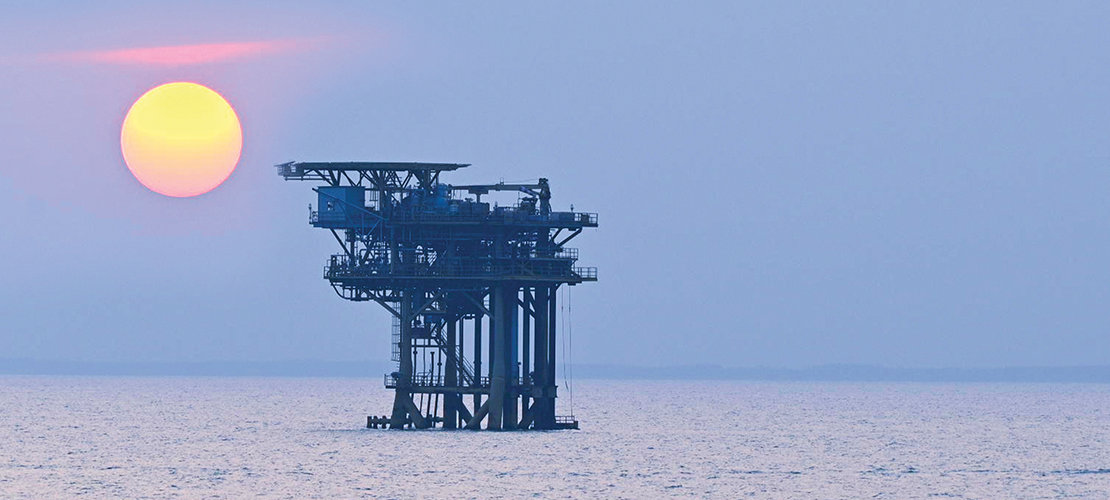
We successfully announced the gas discovery in Ambe Block, marking the first Discovered Small Field (DSF) Block to be monetised on India’s West Coast. The discovery has added ~ 13 mmboe of Reserves and Resources (R&R).
The Ambe discovery is being monetised through a Conductor Supported Platform (CSP) development concept. This approach enables lightweight, modular shallow water platforms by utilising drilling conductors as the primary structural support, thereby significantly reducing offshore development timelines and capital costs. The project is being executed in collaboration with 2H Offshore Engineering, reinforcing our focus on innovative, cost efficient development solutions.
Drilling preparations are ongoing in North-East region to explore the prospects in the block.
Vedanta’s Oil & Gas business has a robust portfolio mix comprising exploration prospects spread across basins in India, development projects in the prolific producing blocks and stable operations which generate robust cash flows.
The key priority ahead is to deliver our commitments from our world-class resources with ‘zero harm, zero waste and zero discharge’:


